
What advertised monthly payment offers reveal about finance rates, powertrain focus, and vehicle segments across seven European markets
A consumer in Great Britain browsing new-car finance sees a median advertised rate of 4.9%, roughly half the 9% typical of a standard consumer loan. In Spain, the same buyer sees 8.8%, around two points above the local consumer-loan benchmark.
This highlights what competitive offers look like in varying markets today, and how different they can be between European countries. But advertised finance offers change and update almost constantly, as manufacturers adjust to maintain their desired positioning. For OEM pricing teams and captive finance houses, that creates a specific problem; a model’s position within its segment set can change from one month to the next, even when nothing on your side has moved. Notice that late and you're repricing against a market that has already moved on.
This analysis of advertised monthly payment offers across seven European markets between January and September 2026 shows how different the picture is from one country to the next and how far the markets can move within few short months.
Great Britain, Germany, and Italy price APR auto finance below consumer-loan rates
Advertised vehicle finance rates differ significantly across the markets analysed. To put them in context, we compared the median advertised rate in each market* with a broader consumer-loan benchmark.
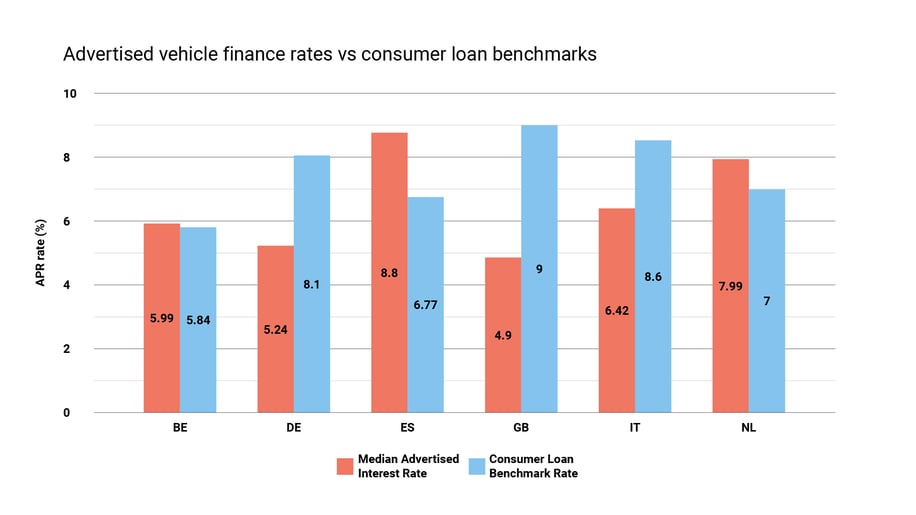
*France is excluded from this comparison because no advertised interest-rate data was available in the analysed offers.
In Great Britain, Germany, and Italy, advertised finance is priced well below wider consumer borrowing. The gap is widest in Great Britain, at around 4.90% against a 9.00% benchmark, followed by Germany (5.24% vs 8.10%) and Italy (6.42% vs 8.60%). In these markets, a low headline rate appears to be one of the main levers in how offers are positioned.
Elsewhere, the picture reverses. Belgium is broadly aligned with its benchmark, at 5.99% against 5.84%. Spain and the Netherlands sit above theirs; 8.80% against 6.77% in Spain, and 7.99% against around 7.00% in the Netherlands.
That changes what “competitive” means. A 6% rate would sit well below the Spanish median but above the British one. These differences may reflect finance-provider strategies, vehicle mix, promotional support, and local market conditions, but the result is the same - a rate that stands out in one market can look expensive in another.
The Netherlands leads BEV finance offers at 34%, Germany combustion at 31%, Italy mild hybrids at 44%
The vehicles behind those offers also change considerably from market to market. Across the overall sample, mild hybrids account for the largest share of finance offers at around 36%, followed by combustion vehicles at around 24% and BEVs at around 23%. PHEVs represent around 14%, while HEVs account for a comparatively small share.
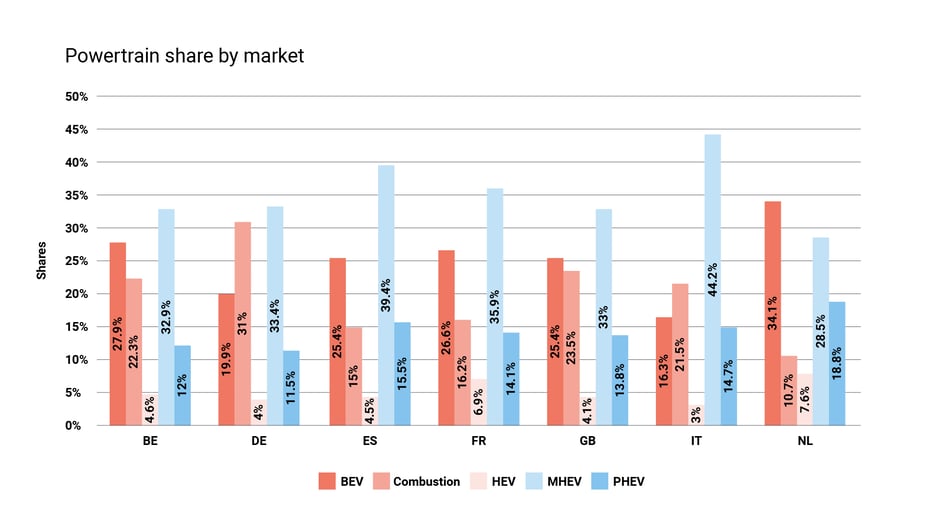
The Netherlands stands out for its strong representation of BEVs, which account for around 34% of offers - the top powertrain in the market and the highest BEV share among the seven - while combustion vehicles represent only around 11%. Germany shows a different pattern; combustion accounts for around 31% of offers, the highest share of any market. In Italy, mild hybrids account for around 44% of offers, while BEVs represent only around 16%.
Belgium, Spain, France and Great Britain sit in between. BEVs make up around a quarter of offers, and mild hybrids remain the largest single powertrain in each.
So while electrified vehicles feature prominently in all seven markets, the type of electrification being supported through finance differs considerably. A BEV finance offer in The Netherlands competes in a very different field from one in Italy.
Belgium's finance offers concentrate on SUVs, Germany's on lower-medium cars, Italy's on upper-medium
Across the full sample, no single vehicle segment dominates finance activity: the eight largest segments together account for around 67% of all monthly payment offers advertised. At market level, though, the focus is much more defined.
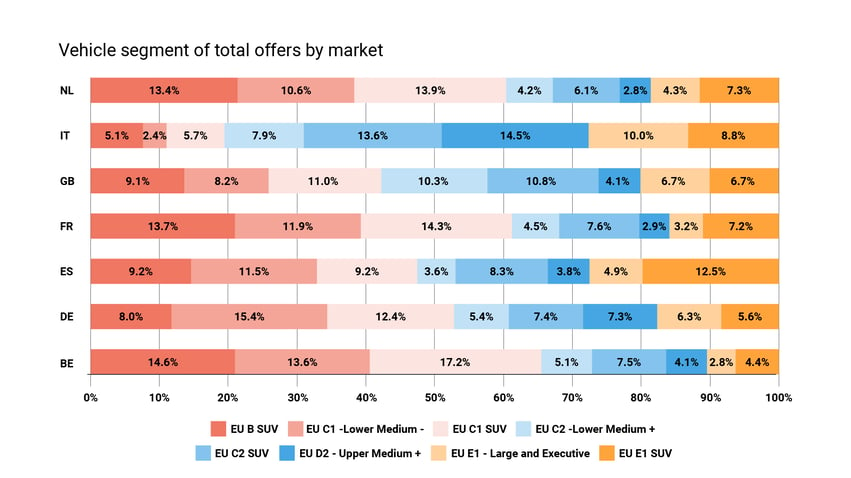
Belgium shows a particularly strong focus on the C1 SUV segment, which accounts for 17% of advertised finance offers, followed by B SUV at around 15%. France and the Netherlands follow a similar SUV-led pattern. Germany differs, with the C1 lower-medium segment the largest at around 15% of offers. Italy stands out most clearly: the D2 upper-medium+ segment represents around 15% of offers, while B SUV accounts for only around 5%.
Where finance activity is concentrated shapes the competitive set around any one offer. The same model can face a crowded field of finance offers in one market and far fewer in the next.

Also from JATO | Introducing Competitive Analysis
The kind of continuous market-level finance tracking behind this analysis is what Payments Analysis is designed to do.
Part of JATO’s new Competitive Analysis platform, Payments Analysis helps automotive finance teams identify competitor finance changes sooner, understand what is driving them, and spend less time manually investigating competitor activity. Launching November 2026.
Advertised finance offers change regularly in each market: What this means for OEM pricing and finance teams
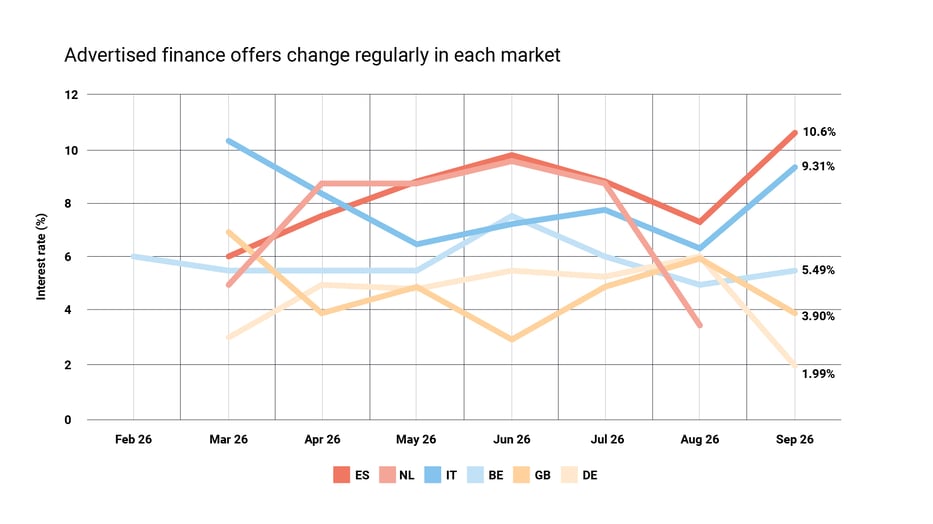
Market averages only go so far. What matters to a pricing or finance team is where their own offer sits against their competitors, and how quickly that can change.
The differences between markets also show up between directly competing models within them. In Germany, the Audi Q4 e-tron and the BMW iX1 advertise monthly payments within €30 of each other, at around €794 and €767, which on the surface suggests two closely matched offers. The finance structures beneath them are built quite differently, though.
BMW leads on headline rate at 1.99% against Audi’s 4.25%, with a final payment of around 53% of vehicle value, while Audi carries the higher rate but structures its offer with a much larger upfront-plus-final component, at around 25% of vehicle value against 10% for BMW. The gap between the advertised monthly and the true monthly equivalent cost of the car is €321 for Audi and €128 for BMW, so two offers that look nearly identical to a consumer are in fact positioned quite differently underneath.
The UK’s B-SUV segment shows a similar dynamic within a different market structure. The Nissan Qashqai sits below the Kia Sportage on both rate (2.49% against 5.9%) and advertised monthly (£555 against £644), yet both offers carry sizeable gaps between the advertised monthly and the true monthly equivalent — £417 and £627 respectively — because PCP structures in the UK tend to defer close to half the vehicle’s value into the final payment.


