


We look at why the vehicle detail page must evolve from a passive advert into a useful decision-support experience if online retailers want to keep up.
The vehicle listing is now a decision point
Buying a car has never been a simple online transaction. It is a high-value decision that involves research, comparison, emotion, budget, practicality, and trust.
What has changed, however, is where the majority of that decision-making process now happens. Today’s buyer may still visit a dealership, speak to a sales adviser, and inspect the vehicle in person. But before they get there, they have often spent weeks researching models, comparing alternatives and trying to work out which vehicle genuinely fits their needs.
Auto Trader found that 94% of UK car buyers research online [1] as part of their buying journey, while 91% also visit a dealership. Digital and physical retail are not competing models, they are connected stages in one journey.
Yet, many vehicle detail pages still look and behave like classified adverts showing a gallery, a price, a finance estimate, an equipment list, and an enquiry form. While these elements remain important, they mostly answer ‘what is this car?’.
But the more valuable question should be ‘is this the right car for me?’.
That shift changes the role of the vehicle detail page: it must move beyond presenting information and help customers make sense of it.
Why online confidence matters more than ever
The scale of online research makes it impossible to ignore how you approach your digital platforms. Auto Trader research [2] also found the average car-buying research period lasts 87 days and that only 7% of buyers know which retailer they want to purchase from at the outset.[3]
For retailers, marketplaces, and OEMs, the implication is commercially significant. It means that while the dealership remains important, the quality of the digital journey shapes the quality of the physical opportunity. By the time a customer reaches the forecourt, they may already have spent weeks exploring vehicles, finance options, reviews, marketplaces, manufacturer websites, dealer websites and competing offers.
The customer is likely to be better informed, but not necessarily more certain. That makes the vehicle detail page a crucial stage in the online buying journey: the point where interest can become intent.
The traditional listing answers too little
-1.jpg?width=708&height=341&name=Image%20(18)-1.jpg)
Too often, the vehicle detail page is treated as the end of the journey. In reality, it is often where the most important evaluation begins.
Clicking on a listing is not the same as choosing a car. Buyers may still be asking whether the vehicle is practical enough, efficient enough, well-equipped enough or competitively positioned against similar alternatives.
J.D. Power’s 2026 U.S. Manufacturer Website Evaluation Study reinforces this point: even among shoppers who already knew which vehicle they wanted, 83% still visited the manufacturer’s website to support their research. Among those still undecided, the figure rose to 94%.[4]
If the page fails to help buyers evaluate suitability, it asks for commitment before confidence has been established. That is when browsers leave rather than enquire.
Signs your listing is still functioning as a classified advert
- The page displays specifications but does not explain why they matter
- The primary next step is a generic enquiry form
- Important trim differences are buried inside long equipment lists
- EV range and charging information appear without practical context
- Standard equipment, optional equipment, and fitted equipment are difficult to distinguish
- Buyers must open another tab to understand the alternatives
- Success is measured almost entirely through lead submissions
.png?width=706&height=438&name=Untitled%20design%20(12).png)
Information is not the same as understanding
More data does not automatically create more confidence. A listing can show boot capacity, battery size, charging speed, power output, safety features and equipment packs, yet still leave buyers unsure about what should shape their choice. The issue is not a shortage of information; it is the lack of prioritisation, interpretation and context.
Google describes the space between initial interest and purchase as the “messy middle”, where consumers move repeatedly between exploration and evaluation.[5]
Clear explanations of important product characteristics can help buyers simplify choices and build confidence. As model choice and vehicle technology expand, this need for explanation becomes more important. The SMMT reported that UK buyers had more than 160 battery-electric models to choose from by the end of 2025, with at least 60 more expected in 2026.[6]
Safety technology is also becoming more complex, as Euro NCAP has observed. [7] In this environment, a feature name alone is not enough. Buyers need to know whether a capability is relevant, whether it is included on the specific vehicle and why it matters in daily use.
Baymard Institute’s ecommerce usability research found that insufficient product descriptions can cause users to abandon a product or website or make incorrect assumptions. [8] Automotive retail is different from ecommerce, but the behavioural principle still applies: when suitability is hard to judge, confidence deteriorates.
What a decision-support listing looks like
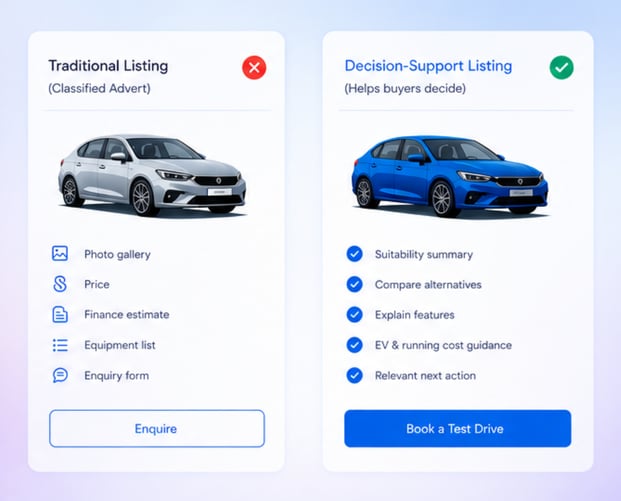
A modern vehicle detail page does not need to be crowded with widgets, technical fields or competing calls to action. The most effective experiences are often the simplest. The objective is to help the customer understand more at each step, without overwhelming them.
The difference extends beyond the information displayed on the page. Traditional listings are designed to present inventory once a customer has largely decided what they want, with success measured by enquiries submitted.
Decision-support listings recognise that many buyers are still evaluating their options. They help customers build confidence, support comparison, explain relevance and guide the next best action, measuring progress through engagement and decision-making rather than form completions alone.
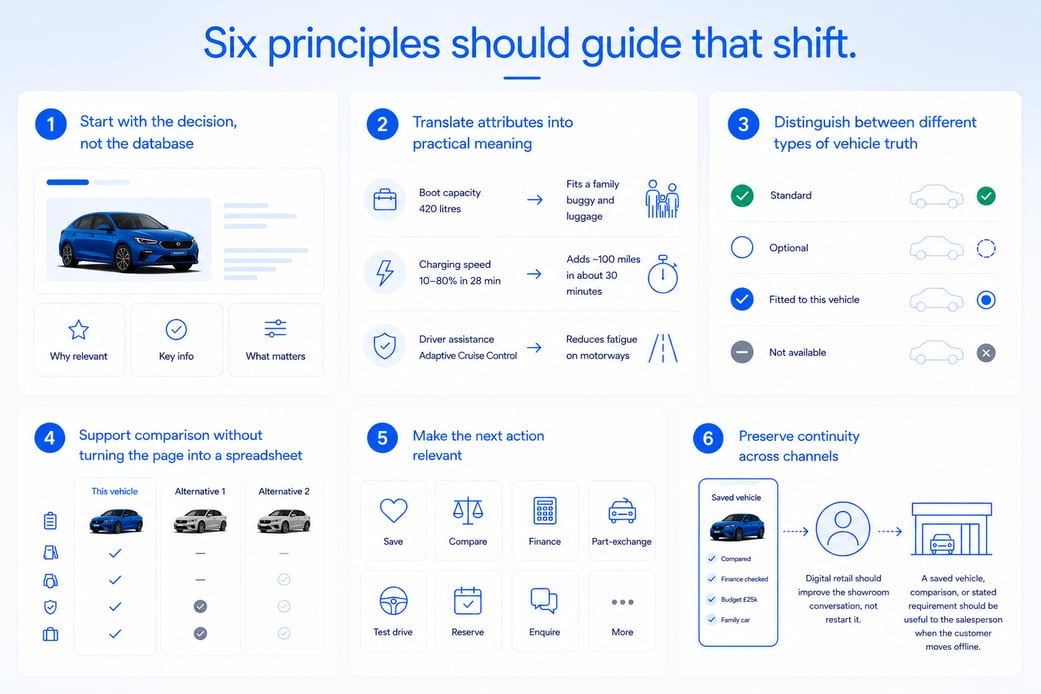
Creating a decision-support listing is not about adding more information—it's about presenting the right information, at the right time, in the right way. Every interaction should help buyers answer a question, build confidence or move one step closer to a decision. The six principles below provide a practical framework for designing vehicle listings that support modern digital retail.
The commercial opportunity
A more useful listing is not simply a UX improvement. It is a commercial opportunity.
When a vehicle detail page genuinely supports the evaluation stage, the effects ripple across the entire purchase journey. Buyers who find answers earlier are less likely to abandon the page without acting. Those who arrive at an enquiry form with clearer intent tend to be better qualified leads. Sales teams spend less time re-establishing basic facts and more time discussing what actually matters to the customer. And when the data source is authoritative and consistently presented, the risk of inaccurate claims in the sales conversation is reduced before it arises.
The opportunity is not uniform. It differs by audience, channel and the point at which a buyer enters the journey. That variation is worth understanding before deciding where to invest.
Comparison sits at the centre of this. Buyers are already comparing vehicles, trims, prices and alternatives whether or not the retailer makes it easy for them to do so. The question is not whether comparison happens. It is where it happens and who benefits when it happens somewhere else.
That question is the focus of the next paper in this series.
The data foundation beneath the experience
Turning a vehicle listing into a decision-support experience depends on more than improved copywriting, polished design, or additional website functionality.
It depends on the quality of the vehicle data beneath the interface.
A retailer can redesign the page, add new tools, and introduce more content. But if the underlying vehicle information is inconsistent, incomplete or difficult to interpret, the experience will still struggle to answer the buyer’s most important questions accurately.
The next generation of digital automotive retail therefore requires a stronger foundation: consistent vehicle identity, structured specifications, standardised taxonomy, and a clear understanding of the difference between standard equipment, available optional content and the features fitted to an individual vehicle.
That is where structured vehicle data becomes critical.
For organisations building digital retail experiences, the quality of the data layer determines how confidently a listing can explain the vehicle, highlight key differences, and support the next customer action.
How JATO supports this shift
JATO’s capabilities can support the full journey from identifying the correct vehicle to helping a buyer understand why it may be right for them.
- JATO Index enables businesses to search for and identify the relevant vehicle instance, creating a consistent foundation for downstream experiences.
- JATO Specifications API provides detailed, standardised vehicle specifications, including standard equipment and available optional content. This gives retailers, marketplaces, and digital platforms the structured information needed to present vehicles consistently and meaningfully.
- For used-vehicle journeys, VINView and VINView Pro help businesses enrich listings from a VIN or registration mark. Where supported, VINView Pro can provide a more detailed build-level profile, including the options, packs and colours fitted to the individual vehicle when it was built.
- JATO Compare API enables structured vehicle comparisons, helping businesses show customers the differences between a selected vehicle and relevant alternatives.
These capabilities can also be brought directly into the customer journey through JATO’s Car Comparison Web Component, an embeddable digital experience designed to help dealers, marketplaces and OEMs present vehicle differences within their own websites.
It is no longer enough to display more data or place every available field on the page. The opportunity lies in making the right information useful at the point where it can influence the customer’s decision.
The listing must earn the next click
The digital car-buying journey has evolved, but too many vehicle detail pages have not kept up.
Customers still value the dealership. They still want to inspect vehicles, ask questions, and complete parts of the journey in person. But the judgement that determines whether they progress is increasingly shaped online. A static listing is no longer enough.
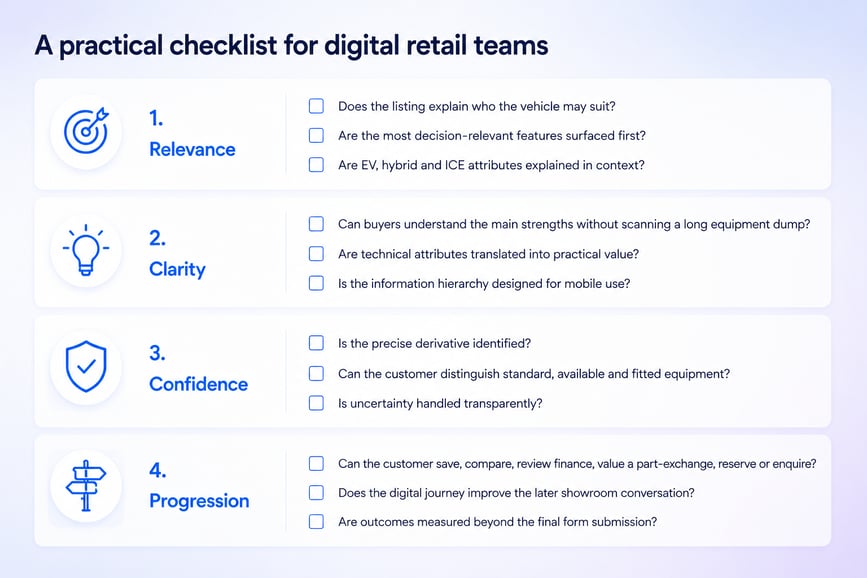
The strongest automotive retail experiences will treat the vehicle detail page as a decision point: an environment that explains suitability, prioritises meaningful information, handles vehicle truth responsibly and gives the buyer a relevant next step.
Turn vehicle listings into decision experiences
Help customers understand the vehicle, compare the alternatives and move forward with greater confidence.
Explore how JATO’s structured vehicle data and APIs can support stronger digital retail journeys.
References
[1] Auto Trader Group plc. “Retailers embracing omni-channel are reporting more sales, improved efficiency and more satisfied customers.” 2023. UK.
[2] Auto Trader Group plc. “Consumers take an average of 87 days to buy a car.” 2024. UK.
[3] Auto Trader. “The unstoppable shift to omnichannel retailing.” 2025. UK.
[4] J.D. Power. “2026 U.S. Manufacturer Website Evaluation Study — Winter.” 2026. US.
[https://www.jdpower.com/business/press-releases/2026-us-manufacturer-website-evaluation-study-winter]
[5] Google. Rennie, A. and Protheroe, J. “How people decide what to buy lies in the ‘messy middle’ of the purchase journey.” 2020. Global consumer research.
[6] Society of Motor Manufacturers and Traders. “UK new car market breaches two million as almost one in four buyers go electric.” 2026. UK.
[7] Euro NCAP. “Euro NCAP Vision 2030: A Safer Future for Mobility.” 2022. Europe.
[Euro NCAP Vision 2030: a safer future for mobility]
[8] Baymard Institute. Krzyminski, A. “10% of E-Commerce Sites Have Product Descriptions That Are Insufficient for Users’ Needs.” 2021. US and European ecommerce research.
[https://baymard.com/blog/product-descriptions]
Additional sources
Baymard Institute. “E-Commerce Product Lists & Filtering UX.” Accessed 2026. US and European ecommerce research.
[https://baymard.com/research/ecommerce-product-lists](https://baymard.com/research/ecommerce-product-lists]
Capgemini Research Institute. “Joining the Race: Automotive’s Drive to Catch Up with Customer Experience.” Published 2025; consumer and executive surveys conducted in 2024. Global.
JATO Dynamics. “Delivering competitive insights. Powering smarter decisions.” Accessed 2026. Global.
Cox Automotive. “2024 Car Buyer Journey Study: Research Summary.” Published 2025. US.
J.D. Power. “2025 U.S. Tech Experience Index Study.” 2025. US.
[https://www.jdpower.com/business/press-releases/2025-us-tech-experience-index-txi-study]