


The cost of gasoline in the United States is rising sharply. On May 12th, the national average reached $4.50 per gallon, an increase of 53.2% since February 23rd. Only two states currently have average prices below $4.00, while California has reached $6.15 per gallon, highlighting the scale of this change across the country.
To serve different markets, manufacturers divide the United States into multiple regions. Incentives such as APR rates and cash offers vary by model and, in some cases, by version. Understanding which offer applies to a specific vehicle in a specific region is already a complex task for dealerships.
Rising fuel costs make this complexity even greater. A customer's driving habits — how far they travel, how often, and for what purpose — now play an important role in determining which vehicle is the right choice for them. At the same time, manufacturers are making faster decisions to adjust incentives in response to fuel price changes. An offer that made a hybrid vehicle the clear financial choice in April may have shifted to favor a combustion model in May, or the reverse. For dealerships, accurately identifying the customer and staying current with incentive changes has never been more important.
Purchasing decision example: Honda CR-V – ICE or HEV?
As fuel costs increase, fuel economy becomes a greater priority for customers when selecting their next vehicle, particularly when price changes occur suddenly. Customers are increasingly open to non-combustion options such as battery electric vehicles (BEV), plug-in hybrids (PHEV), and traditional hybrids (HEV). However, as the national incentive offer on BEVs ended in September of last year and PHEVs represent only a small share of the market, the most common decision customers face today is choosing between an ICE and an HEV, especially within the same model line.
To show this process in practice, we will look at the best-selling model of last quarter, the Honda CR-V, which is available with both a combustion and a hybrid powertrain. While customers cannot switch powertrains within the same trim, Honda has structured its trim lines so that comparable options exist across both. For example, the AWD EX-L and the AWD Sport-L Hybrid share nearly identical standard specifications[1] outside of the powertrain. The primary difference is that the AWD Sport-L Hybrid includes roof rails as standard, whereas they are a paid option for the EX-L.
The list price of the AWD Sport-L Hybrid is $3,325 more than the AWD EX-L ($40,225 vs. $36,900). Assuming the minor specification differences are not a factor, this price gap must be recovered through fuel savings from the hybrid's superior fuel economy (37 combined MPG versus 28 combined MPG for the combustion model). Whether this difference can be recovered will depend on several factors, including the current cost of gasoline, the availability of manufacturer incentives, and the total distance the customer expects to drive over the life of the vehicle.
The sharp return of higher fuel costs
Since gasoline spiked in the middle of 2022, prices in the United States have been relatively consistent, hovering around the three dollars per gallon range for the past three years. However, in recent weeks, gasoline prices have been on the rise, crossing the $4.00 per gallon mark for the first time since July 2022, with the May average currently standing at $4.48 per gallon as of May 12th. This marks an increase of 59.3% since this January.
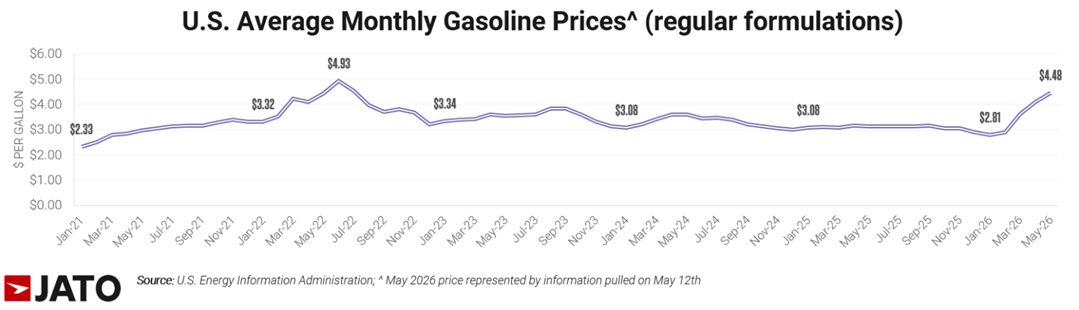
To put that into perspective using our CR-V example, a customer would need to drive just under 159 thousand miles to make up the $3,325 difference if gasoline was at its January 2026 average ($2.81), but only 100 thousand miles at the current May average – or 4.4 years less driving, assuming 13,500 miles per year.
That said, gasoline prices in the United States aren’t uniform and will vary from state to state and county to county. The most expensive gasoline will generally be found in California ($6.15 per gallon as of May 12th) and the west coast, while the least expensive gasoline will be found in the central U.S. (currently Oklahoma at $3.94 per gallon).
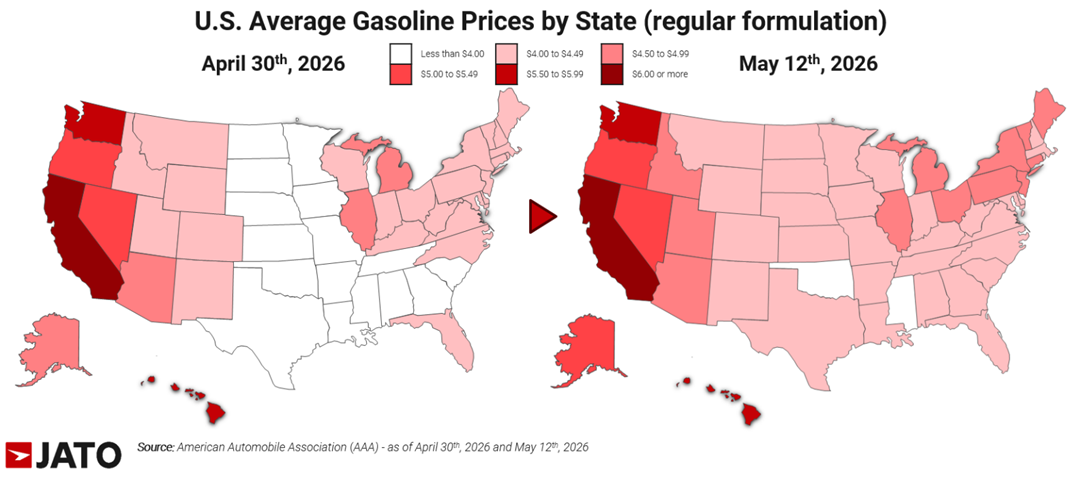
This means the cost of gasoline will heavily depend on the location of the customer, something that is also true when it comes to incentive programs.
Incentives, not list price, settle the comparison
Incentives in the United States are complex as few brands exclusively use national offers. On top of that, each OEM splits the United States into their own personal regions and can and will create more targeted offers by state or even zip code. And while most companies will update their offers on a monthly and quarterly basis, there are brands such as Ford that will make multiple changes and tweaks through the month. When comparing incentives, it is important to recognize that any comparison reflects a specific point in time. The outcome may change depending on when and where the vehicle is purchased.
When looking at the CR-V example, Honda splits its incentives generally into two regions for this vehicle: “Region A” and “Region B”. However, the states that represent these regions differ slightly when considering lease and finance incentives, creating a situation where two states, Illinois and New Mexico, use the lease offers from Region A, but the finance offers of Region B.
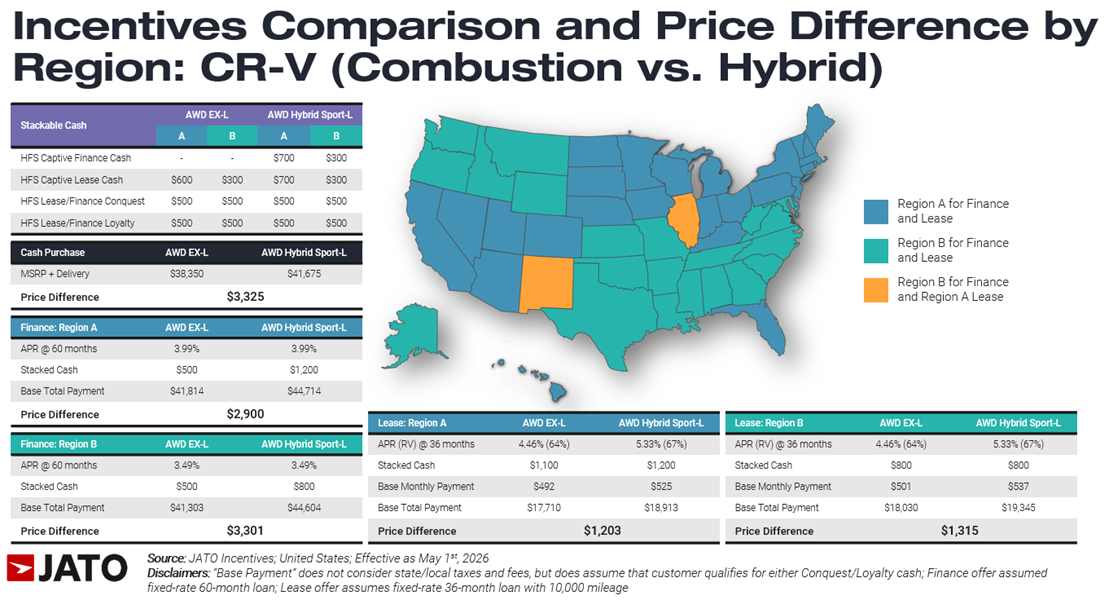
As of May 1st, there are no open cash offers for the CR-V, which means there isn’t a cost reduction for someone making a cash purchase. But not many Americans are able or willing to purchase a vehicle with cash and instead finance or lease their vehicle. In these cases, Honda does offer special incentives for the CR-V, that vary by region and powertrain. In addition to special interest rates, Honda is currently offering a $500 Loyalty/Conquest offer to customers with at least one vehicle from the 2011 MY or newer that can be combined with a captive cash offer, an amount that varies by region, powertrain, and purchase type.
After taking the incentives into account, we can finally see the base amount that a customer is going to have to pay before state taxes and other regional fees are applied. With this information, we can start to understand the real difference between the two powertrains and if it makes sense to go with one vehicle over the other.
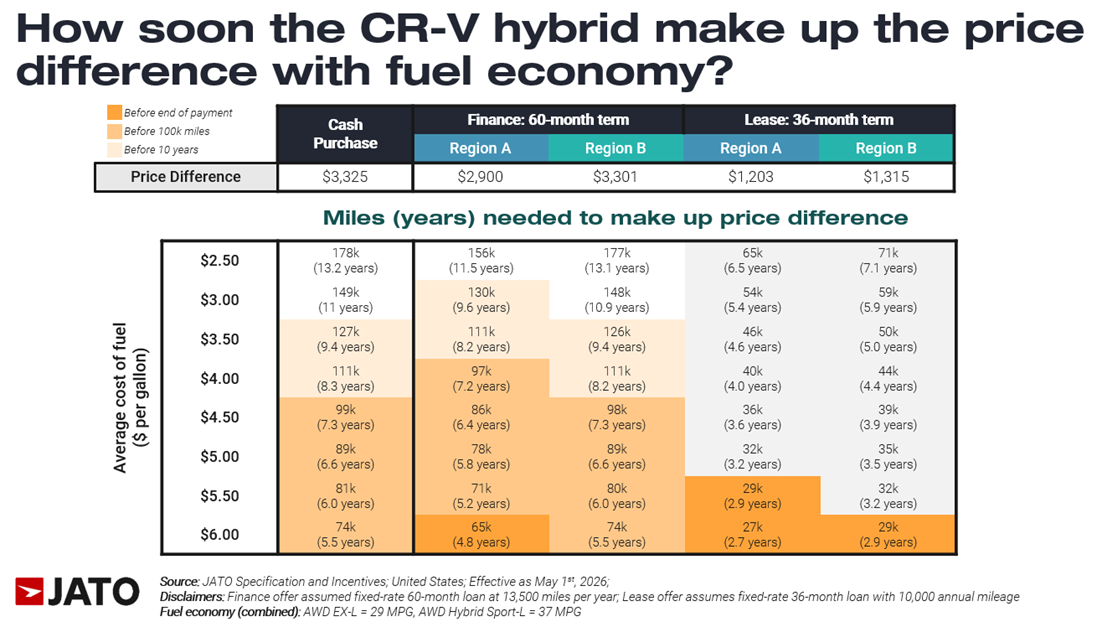
For both cash purchases and financed transactions, the decision between the two vehicles will largely depend on the type of customer buying the CR-V. Customers who intend to drive the vehicle for its full life cycle, should find the hybrid to be the stronger choice, unless they reside in a state with relatively low gasoline prices and believe that costs will not only return to pre-2026 levels, but fall below $3.00 per gallon. For customers who plan to sell the vehicle shortly after paying it off, the decision will depend more on whether they view the current fuel prices as a short-term spike (as seen in 2022) or whether this is likely to become the new normal.
For customers leasing a CR-V in May, the choice appears clear, as it would be unlikely for a customer to recoup the price difference within the allotted mileage, unless the price of gasoline exceeded $6.00 per gallon for the entire term of the lease. However, it should be noted that April was a different story. The incentives were stronger for the hybrid, bringing the base monthly payment for the AWD EX-L and AWD Sport-L Hybrid to be nearly identical. This means that while the clear choice in May appears to be the combustion engine (AWD EX-L), the previous month's answer would have been the hybrid (AWD Sport-L Hybrid), as customers would begin saving money through fuel economy after the first few fill-ups.
The decision now comes down to timing and usage
In the end, while this spike in the price of gasoline will cause customers to increase their interest in hybrid and other vehicles with better fuel economy, whether this results in more hybrid sales will ultimately rest with OEMs and dealerships as they look to guide the market through changes in list pricing and incentives.
For dealerships, fuel costs being in flux adds further importance to understanding the type of customer they are selling to, as driving habits will greatly influence which vehicle is the right choice for them. For consumers, it means being even more vigilant about finding the right time to buy, as manufacturers will be making faster and more reactive decisions to adapt — turning what could be a clear choice to lease a hybrid in April into an equally clear choice for the combustion version in May, and vice versa.
[1] As per JATO Cars Specifications database, running JATO Value Analysis