


Electrification has fundamentally reshaped the global automotive industry, which has been transformed further with the rapid emergence of Chinese automakers in the European market. For automotive retailers, the influx of these electric vehicles (EVs) presents a significant commercial opportunity with more models and varying price points to offer customers.
However, the pace of market entry and the complexity surrounding how these vehicles are presented and sold creates a genuine challenge. Retailers who want to capitalise on this opportunity need to understand what they are selling and how to sell it.
The growth of Chinese brands
Established European automakers have historically operated on lengthy development cycles, often taking four to five years to bring a new vehicle to market. Chinese automakers have disrupted that model, compressing the same process into as little as 16 to 24 months. The stark disparity in speed to market is changing the competitive landscape and placing considerable pressure on the entire automotive ecosystem, retailers included, to adapt to the way they operate.
To put it into perspective, across France, Spain, Italy, Germany, Luxembourg, the Netherlands and Belgium, Chinese battery electric vehicle (BEV) penetration has strengthened notably between January 2023 and January 2026. BEVs began 2023 at 20.68%, climbing to a high of 41.61% in August 2023 and levelling out at 27.01% in January 2026.
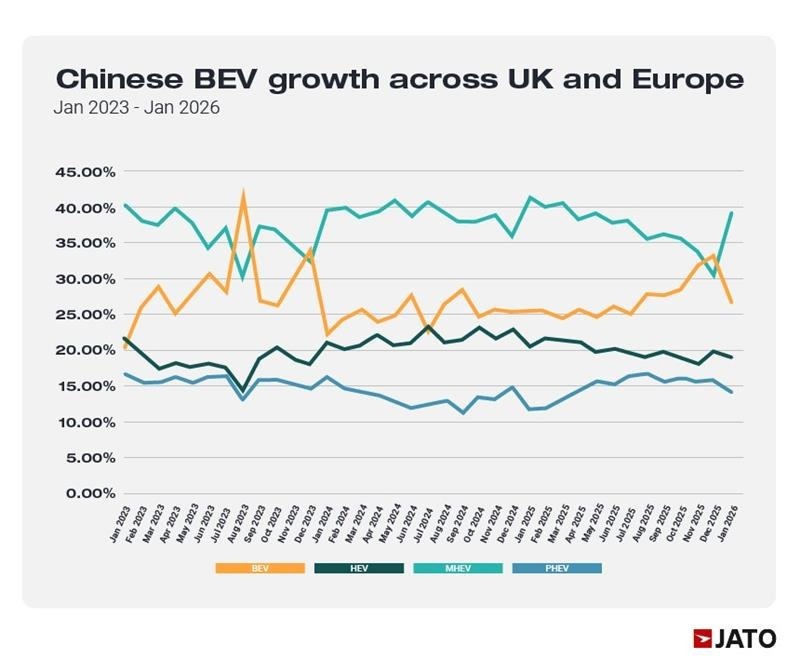
Despite some month-to-month volatility driven by incentives, supply dynamics and seasonal effects, the underlying trend is clear: BEVs have shifted from roughly one fifth of the market in early 2023 to around one third by early 2026. This steady upward trajectory highlights growing consumer adoption, wider model availability, and broader market readiness across these seven European countries.
To put that into perspective with regards to growth on domestic shores, in China in the last 10 years, the number of makes grew by 38%, whereas the number of models increased by 30%.
In Germany, the number of makes grew by 33%, whereas the number of models increased by 17% and in Great Britian the number of makes grew by 25%, whereas the number of models increased by 13%.
The knowledge gap
With the continuous flow of new EVs entering the market, retailers have a unique opportunity to expand their vehicle portfolios, offering a wider range of options to suit all budgets, particularly in the growing electric vehicle segment. However, the introduction of new brands from manufacturers with limited or no established presence can be both challenging and risky when vehicle details and specifications vary from their EU counterparts.
Retailers require data that is not only standardised but comprehensive enough to support inventory decisions, vehicle listings, valuations, and customer-facing experiences, all of which must keep pace with the rapid rate of new model releases entering the market. The ability to accurately identify any vehicle quickly is fast becoming an operational necessity for retailers looking to list and sell with the speed the market now demands.
JATO Index, part of the JaaS API suite, supports retailers with this exact need. Built on a uniquely structured data hierarchy, the Index enables retailers to identify any vehicle accurately within just a few clicks, even without a VIN. Its classification framework connects makes, models, generations, body types, variants, trims, and equipment in a simple, intuitive pathway.
By delivering accurate vehicle level insights, real time market data, and seamless integration into core retail processes, the platform empowers retailers to respond to market shifts as quickly as the OEMs driving them.
From optimising stock mix and pricing with confidence to ensuring every listing is consistently accurate and competitive, JATO Index provides the intelligence needed to operate at true market speed, making decision making smarter, faster, and more reliable.
Keeping pace
Automotive retailers operate in one of the fastest moving product landscapes in the world. Each year brings a surge of new makes, models, and versions. While this represents a compelling commercial opportunity for retailers, it also requires the ability to move quickly and with confidence. Access to comprehensive and real-time vehicle data is what enables retailers to identify, list, value, and sell new models effectively as soon as they arrive, ensuring they are positioned to maximise opportunities as they emerge.
To understand how JATO Index can transform your retail business, book a demo to discover the full JaaS API suite.