


Over the past decade, India’s passenger car market has undergone a profound transformation. Sport utility vehicles (SUVs), once considered a niche category, now account for more than half (54.8%) of all new passenger car sales. This shift in reshaping vehicle design is quietly redefining tyre demand, tread patterns, and aftermarket strategy.
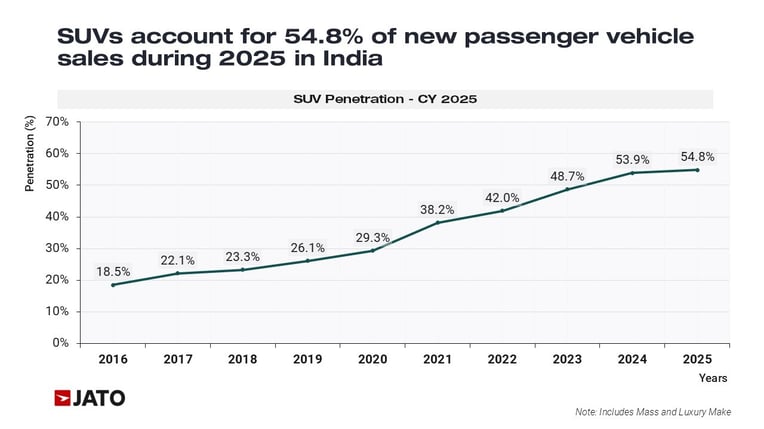
For tyre manufacturers, the rise of SUVs represents far more than a change in consumer preference. It signals a structural shift in tyre size requirements, durability expectations, and replacement demand across India’s car parc.
Understanding how this transformation plays out across the vehicles already on the road is increasingly critical for strategic planning. Vehicle parc intelligence from companies such as JATO Dynamics becomes even more essential during this phase.
A market shift from hatchbacks to SUVs
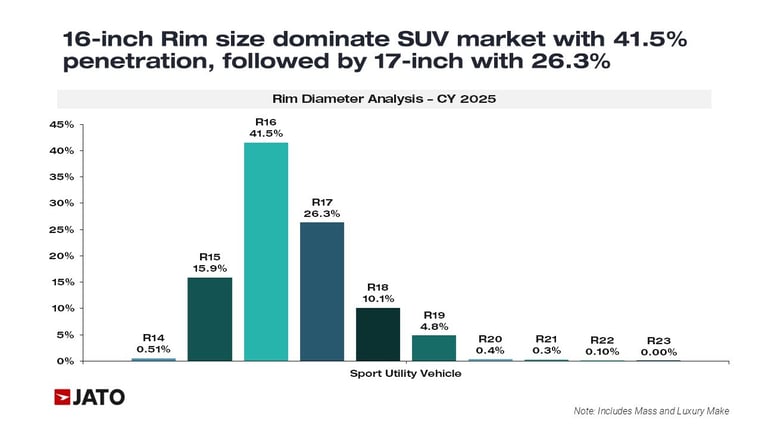
For many years, India’s passenger car market was dominated by small hatchbacks with models that typically used smaller tyre sizes designed primarily for fuel efficiency and urban driving. The rapid rise of compact SUVs has fundamentally changed this pattern. Unlike hatchbacks, SUVs require tyres with larger diameters, wider tread widths, and higher load capacity. As a result, sizes such as 205/55R16, 215/60R16, and 215/65R16 are becoming increasingly common in new vehicles entering the market.
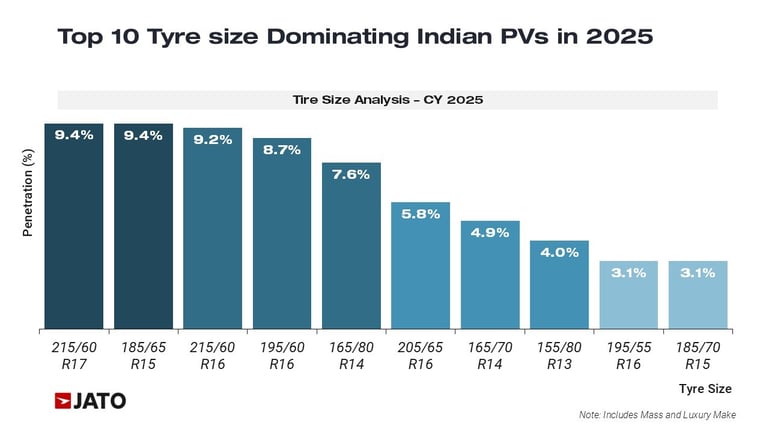
While this shift may appear subtle, its implications are significant. Larger tyres command higher price points, meaning the continued growth of SUVs is gradually increasing the overall value of the tyre market.
Why do SUV tyres require different tread designs?
SUVs operate under different conditions from traditional passenger cars. Even when primarily used in cities, these vehicles regularly encounter a mix of environments such as highways, uneven urban roads, gravel or semi-rural surfaces, and monsoon-affected roads. To handle these varied conditions effectively, SUV tyres often incorporate deeper grooves for water evacuation, larger tread blocks for durability, and reinforced sidewalls for impact resistance. Together, these features balance several competing requirements including wet-road safety, ride comfort, and long-term wear resistance.
In a market like India, where road conditions vary widely, tread durability is a particularly important consideration. Tyre manufacturers frequently highlight stronger tread patterns and longer wear life as key selling points for their SUV-focused product ranges.
The aftermarket opportunity
The implications of SUV growth extend well beyond new vehicle sales. Tyre demand is largely driven by the replacement market more so than the original equipment. Once vehicles enter the active fleet, they continue to generate replacement demand for many years.
Vehicle parc data highlights this dynamic. By analysing vehicles currently in operation alongside their associated tyre specifications, manufacturers can identify which sizes are most likely to dominate future replacement demand. A surge in SUV sales today, for example, typically leads to increased demand for larger replacement tyres three to five years later, when those vehicles begin their first replacement cycle. This delayed effect is precisely why understanding the composition and age distribution of the active fleet is essential for accurate tyre market forecasting.
Consumer expectations are changing too
As SUVs become more common on Indian roads, consumer expectations around tyres are evolving. SUV owners increasingly prioritise durability for rough road conditions, strong wet-road grip during the monsoon season, and tread patterns that signal toughness and reliability. In many retail environments, buyers still rely heavily on dealer recommendations, but visual tread design continues to influence purchasing perception. Larger, more aggressive tread blocks are widely associated with strength and off-road capability, even when vehicles are primarily driven on paved roads. For tyre brands competing in India’s highly competitive replacement market, balancing genuine performance characteristics with visual appeal has become an increasingly important consideration.
Why vehicle parc intelligence matters
The long-term impact of SUV growth can only be fully understood by analysing the vehicles already on the road. Datasets that track vehicles in operation, their tyre specifications, and segment growth trends allow manufacturers to anticipate where replacement demand will emerge in the coming years.
JATO uses these datasets to help tyre manufacturers understand which vehicle segments dominate the car parc, which tyre sizes are most common in operation, when vehicles will enter replacement cycles, and how broader market trends will shape future demand. This intelligence enables tyre companies to align product development, production planning, and aftermarket strategy with real-world market conditions — rather than relying on new vehicle sales data alone.
Looking ahead
India’s shift towards SUVs represents one of the most important structural changes in the country’s automotive market. While the immediate impact is visible in vehicle showrooms, the longer-term consequences will play out across the tyre industry as these vehicles enter the replacement cycle.
For tyre manufacturers, the challenge will be to design products that meet the evolving demands of SUV drivers whilst anticipating future market shifts. Combining engineering expertise with vehicle parc intelligence will be essential to identifying where the next wave of tyre demand will emerge. As India’s car parc continues to evolve, the ability to connect tread design, vehicle usage patterns, and market data will increasingly define competitive advantage across the industry.