


In recent years, the automotive industry has made huge strides in automation. Today, many cars, even mid-range models, can automatically adjust speed, brake in emergencies, stay in their lane, and maintain a safe distance from the vehicle ahead.
Technology, in short, has done its job. Regulations, however, are moving at a much slower pace and it’s not just a bureaucratic issue. When a car drives itself, sensitive topics come into play: user safety, of course, but also liability in the event of an accident, protection of data collected by vehicles, and how these innovations integrate with insurance systems, traffic enforcement, and local administrations. In short, new sensors and algorithms aren’t enough: a new regulatory framework is needed.
Not all forms of autonomous driving are the same, though. Today we are in a transitional phase between vehicles that simply assist the driver and systems that begin to partially replace human control. The SAE (Society of Automotive Engineers) classification, commonly adopted and ranging from 0 to 5, helps frame the progress. Most cars on the road fall into levels 1 and 2: they can brake on their own, steer on highways, but the driver remains fully responsible. The real turning point comes with level 3, where the system can manage driving under certain conditions, such as low-speed highways or heavy traffic, and the driver can take their attention off the road—though they must remain ready to regain control. This is where regulation makes the difference, because for the first time, it’s the vehicle, not the human, that makes decisions about trajectories, braking, and speed.
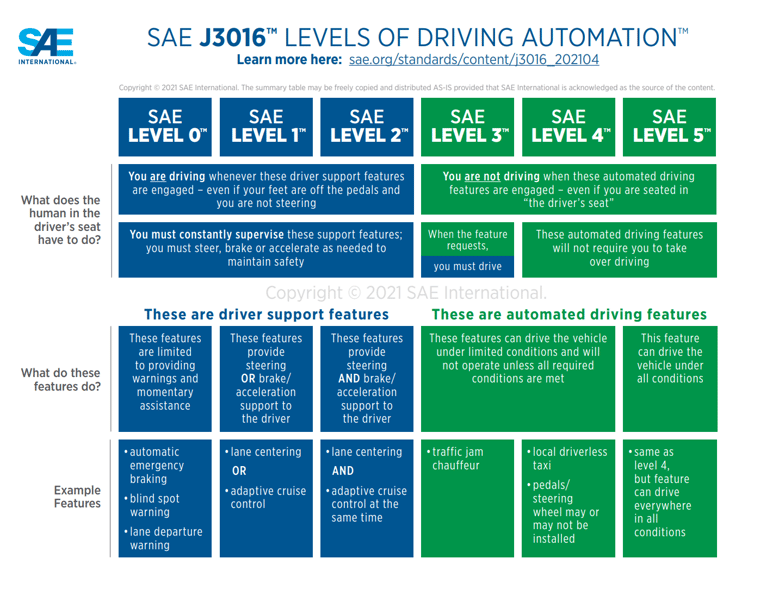
Analysis of Europe’s autonomous car levels of driving automation in autonomous cars.
Market penetration
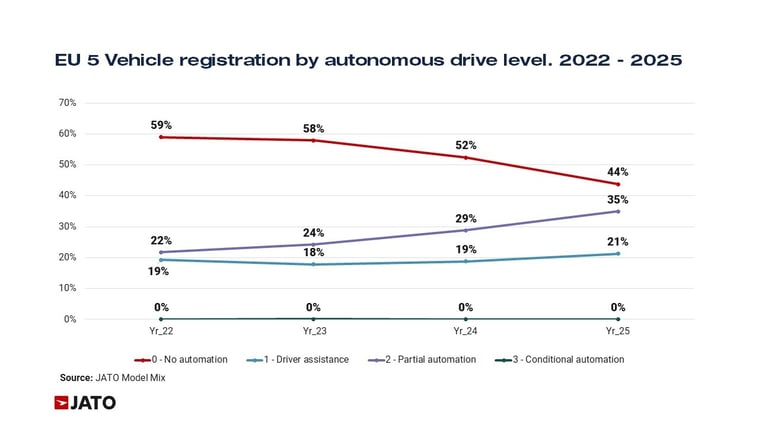
Looking at the volume data over the past four years, an interesting perspective emerges on the potential opportunities for developing different levels of autonomous driving technology.
Considering Germany, France, Italy, Spain, and the United Kingdom as a single aggregated market, data shows that in 2022 nearly 59% of new cars had no form of automation, but today that share has dropped below 44%. The most striking change is in Level 2 systems, which can control both steering and acceleration in specific conditions. These features have jumped from 22% in 2022 to 35% in 2025—meaning more than one in three vehicles now offers this capability. Level 1 driver assistance systems have held steady at around 21% of the market. Level 3 automation, which allows true hands-off driving in limited scenarios, remains rare with adoption close to zero.
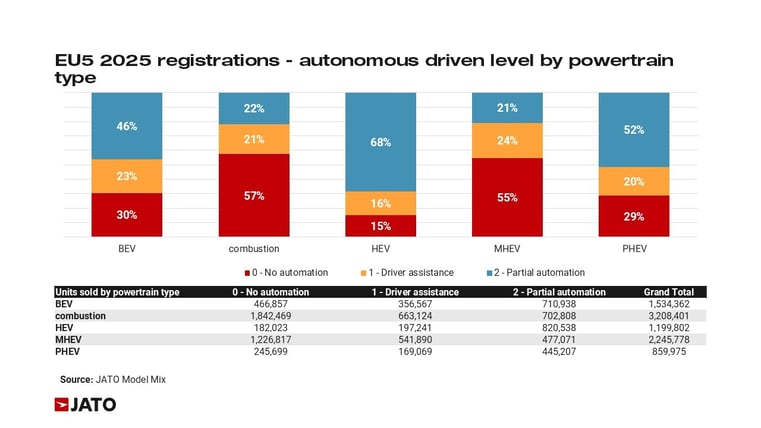
Analysing the most recent data (full year 2025) on growth by powertrain type, HEVs are the strongest adopters of automation: around two thirds of registered pure hybrids include Level 2 as standard equipment, half of the remaining HEVs offer Level 1, and only 15% have no automation at all.
Level 2 is also strongly driven by BEVs and PHEVs, highlighting a clear correlation between electrification and automation. Electric and plug-in hybrid vehicles are built on advanced digital platforms like KIA CON EV4, which integrate sensors, cameras, and battery management software, making the implementation of complex Level 2 ADAS systems more straightforward.
A further factor worth noting is the role of technology in improving battery efficiency. Features like Adaptive Cruise Control and Traffic Jam Assist optimise acceleration and braking, which extends the driving range of battery electric vehicles. Electrification and automation are advancing together as complementary innovations.
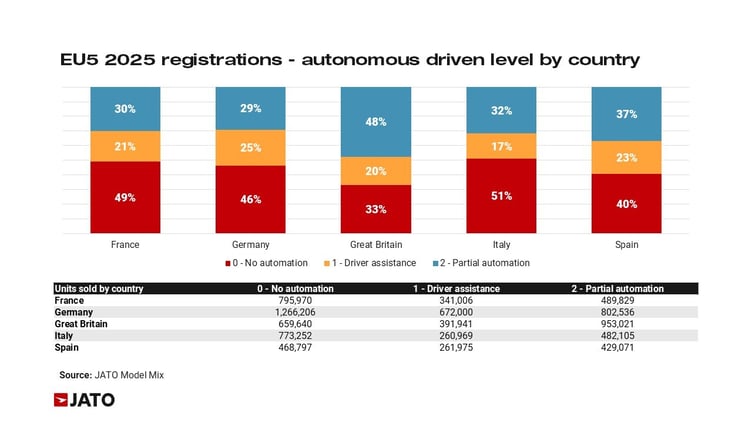
There are significant differences among European countries in the adoption of autonomous driving technologies. Italy and France have the highest share of vehicles without automation, indicating a lower penetration of advanced technologies, likely linked to greater price sensitivity and an older vehicle fleet.
The United Kingdom stands out: 48% of vehicles feature partial automation, the highest value among the countries analysed. This reflects a market more oriented toward innovation and safety, with a greater presence of premium models and new registrations.
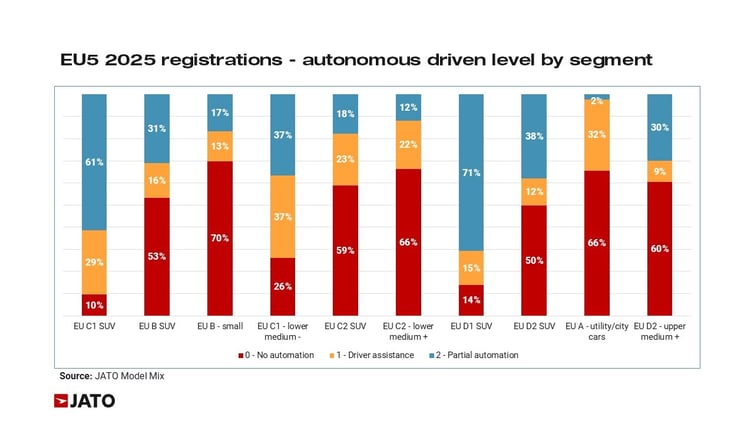
Level 2 Adoption by vehicle segment
Deepening the analysis of the Big 5 market structure, partial automation (Level 2) confirms itself as the dominant technology in high-end SUVs. In particular, the EU D1 SUV segment leads the ranking with a share of 71%, the highest among all analysed segments. Next come C1 category SUVs, reaching 61%, while D2 SUVs stand at 38%.
These figures highlight how medium and large SUVs are the main drivers of advanced driving system adoption, signalling a strong correlation between premium positioning and the integration of automation technologies.
Regulatory drivers
Europe has taken its first concrete steps toward a regulatory framework for autonomous driving. Regulation 2019/2144 has mandated, starting in 2024, that all new cars must include a series of driver assistance systems. However, these are support features, not true autonomy. The real breakthrough comes with UNECE Regulation R157, which allows, for the first time, the official certification of Level 3 autonomous driving systems. This regulation, shared by several European states, sets strict rules: the car can drive itself only on separated roadways, at speeds not exceeding 60 km/h, and only if equipped with redundancies in vital systems such as brakes and steering.
Mercedes set the benchmark with its Drive Pilot system, active in Germany and approved in some U.S. states. It is the first Level 3 autonomous driving system authorised in Europe. But the most interesting novelty is not technical, it’s legal: in case of an accident while the system is active, the company, not the driver, is legally responsible. This role reversal requires new, well-calibrated rules.
Additional recent regulations include UN R155 and R156, which address vehicle cybersecurity and remote software update management. Modern cars are now computers on wheels and must be protected against cyberattacks while ensuring updates do not compromise vital systems.
So far, the European framework appears cautious but evolving. However, several fundamental questions remain open. First and foremost: civil and criminal liability. If an autonomous car causes an accident, who is responsible? The driver who was not actively driving? The vehicle manufacturer? The software provider? Or no one, because it is an inherent system risk? These are issues that could affect the timing and manner of mass adoption.
Another critical point concerns insurance. Current policies are designed for human error. With automation, the risk shifts to technological reliability, and insurers will need to develop new products and formulas to cover events not foreseen by traditional contracts.
And then there’s the traffic code. In many European countries, including Italy, the law still requires every vehicle to have a licensed driver. Phrases like “prudent and diligent driving by the driver” are enshrined in key articles of some traffic codes and simply do not contemplate the possibility of a car acting on its own. Legislative adaptations will be crucial to transition autonomous driving from experimental contexts to everyday life.
Contrasting strategies in major markets
Looking at the rest of the world, the picture becomes even more interesting. In the United States, for example, there is no unified federal law on autonomous driving: each state sets its own rules. Some, such as California, Texas, Arizona, and Nevada—have long allowed on-road testing, with fully autonomous vehicles operating without anyone behind the wheel. Waymo, Cruise, and other operators have launched robotaxi services in some cities, already fully operational. This approach has enabled rapid development but also created inconsistencies, with controversial incidents leading to temporary license suspensions.
In China, the approach is the opposite but equally effective. The central government has defined a national plan for autonomous driving development, integrated into the country’s major innovation projects. Cities like Beijing, Shanghai, and Shenzhen have become advanced testing zones, featuring smart traffic lights, digital signage, and 5G coverage. Chinese tech companies, from Baidu to Pony.ai, are experimenting with Level 4 vehicles, and in some urban areas, driverless shuttle services are already active. It is worth noting that alongside the strategic importance of these innovations, open questions remain about data control and algorithmic decision transparency.
Innovation won't wait
The global trend toward these forms of strategic innovation is evident in concrete data, showing non-uniform regulatory approaches and significantly different visions. Yet this is where the future is being shaped: autonomous driving will not only change how we move but will redefine fundamental concepts such as responsibility, freedom of movement, vehicle ownership, and equity in access to mobility.
Meanwhile, technology continues to evolve, and automakers compete on innovation. Monitoring markets will be key to anticipating trends and identifying growth opportunities.
But for all this to become part of everyday reality, clear, shared, and above all updated rules are essential for the world that awaits us.