


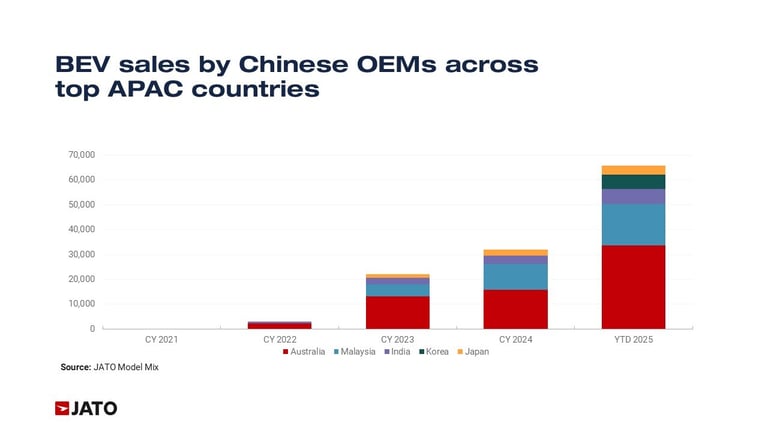
- Chinese OEMs have rapidly scaled APAC BEV presence, capturing 34.4% of the regional BEV market in 2025 up from virtually zero in 2021.
- Growth is BEV‑led, not broad‑based: total Chinese OEM market share remains modest at 1.7%, but BEV share is rising at triple‑digit growth rates.
- Australia and Malaysia together contribute >75% of Chinese BEV volumes, functioning as expansion beachheads before entering more complex markets like Japan and Korea.
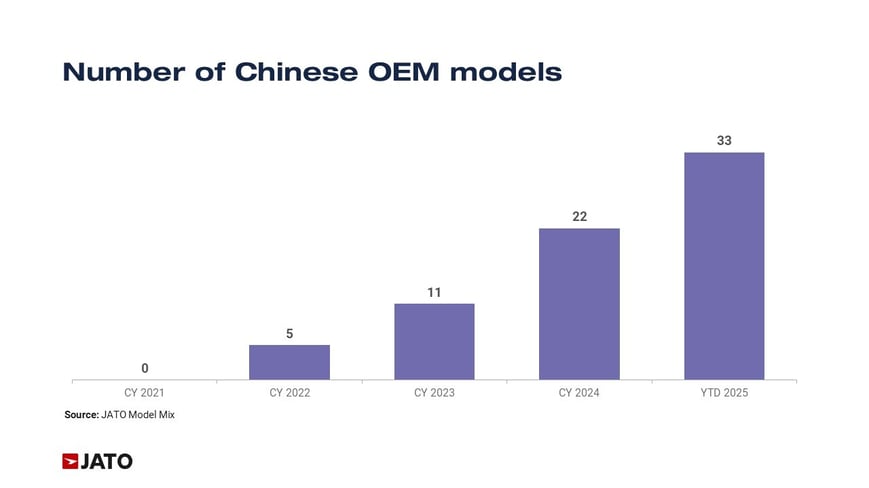
- Model proliferation is the primary growth engine - Chinese OEM BEV models expanded from 0 models (2021) to 33 models (2025).
- Expansion is strong but not guaranteed. Regulatory barriers, localisation demands, and consumer trust challenges could slow growth.
A shifting landscape but not an inevitable one
For decades, APAC auto markets have been anchored by Japanese, Korean, and increasingly Indian OEMs. Yet the rise of Chinese OEMs in the battery electric vehicle (BEV) segment marks a structural shift in the region's competitive order.
However, the trajectory is not linear. While Chinese BEV penetration has accelerated sharply, future momentum will depend on regulatory responses, geopolitical dynamics, brand trust, and localised industrial strategies factors that may reinforce or delay further market share gains.
What's fueling the surge?
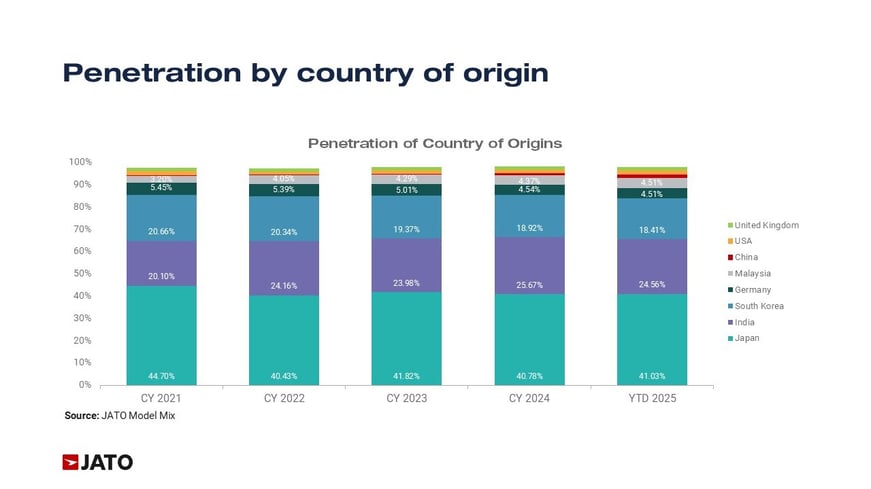
Despite only 1.7% share of total vehicles sold across India, Japan, Korea, Australia, and Malaysia, Chinese OEMs have emerged as the most dynamic force in APAC’s BEV segment:
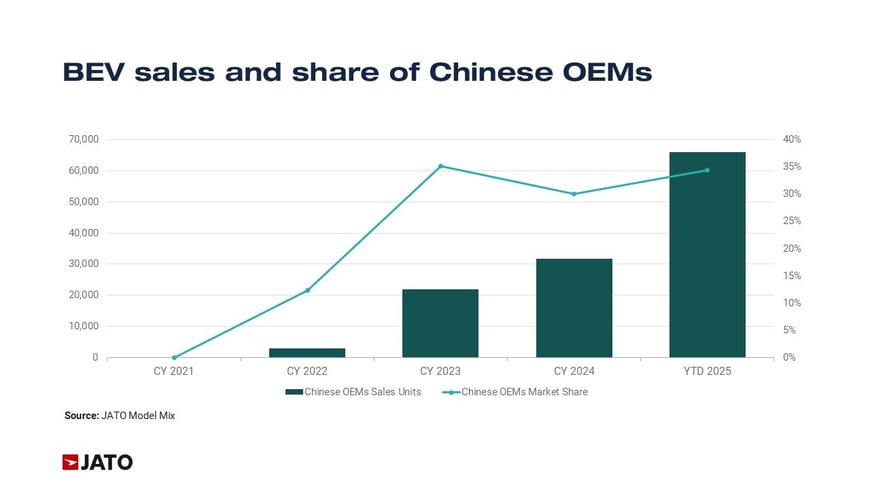
Rapid BEV volume growth(0 → ~66,000 units)
Chinese OEMs have accelerated from virtually no BEV presence in 2021 to nearly 66,000 units sold by 2025,highlighting an unmatched scaling ability in the region. This surge reflects aggressive market entry strategies, strong supply‑chain integration, and the rapid rollout of competitively priced models tailored for APAC consumer needs.
Rising BEV market share(12.4% → 34.4%)
In just three years, Chinese OEMs tripled their BEV market share from 12.4% in 2022 to 34.4% in 2025 outpacing all regional competitors. This expansion underscores their ability to convert model availability and competitive pricing into real market traction, particularly in open and price‑sensitive APAC markets.
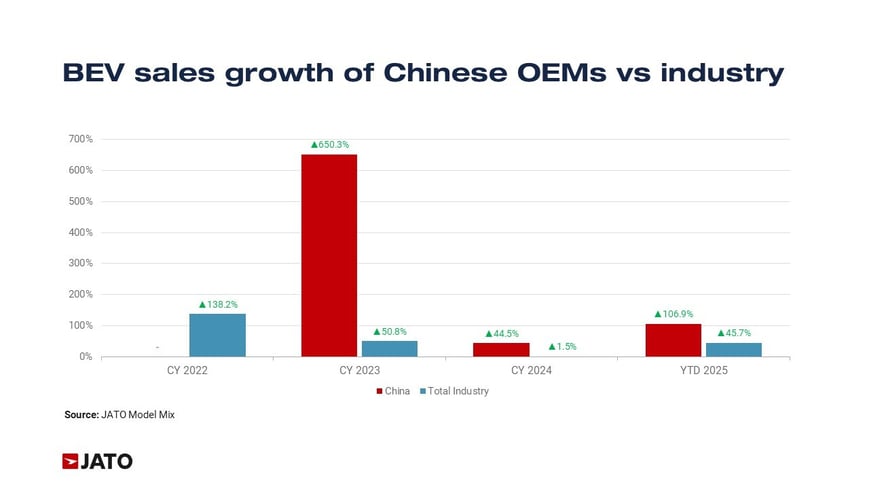
Outperformance amid slowing industry growth
Even as overall BEV growth in APAC cooled to just 1.5% in 2024, Chinese OEMs defied market inertia with a 44.5% surge. Their resilience reflects strong consumer pull, robust supply chains, and attractive price‑to‑value positioning that allowed them to expand despite weakening broader EV momentum.
The key differentiator is product velocity: 33 BEV models now compete across multiple body styles and price points far exceeding the limited EV portfolios of many Japanese and Western OEMs.
Where growth is coming from: Australia & Malaysia
In 2025, Australia (33,749units) and Malaysia (16,532 units) contributed ~50 of 66 thousand Chinese OEMBEV sales across major APAC markets.
Why these markets? They offer open import structures with price‑sensitive buyers receptive to value EVs. Flexible regulatory environments and lower brand loyalty compared to Japan or Korea make them ideal entry points. These markets act as low‑barrier "launch pads," enabling Chinese OEMs to perfect pricing, distribution, and product strategies before expanding into more resistant markets.
Who is impacted and how?
1. Japanese OEMs (Toyota, Nissan, Honda)
Japanese OEMs dominate ICE and hybrids, but lag in BEVs. Rising Chinese BEV adoption threatens future relevance in markets undergoing rapid electrification. Expect accelerated BEV investment and deeper hybrid-to-BEV transition pressures.2. Korean OEMs (Hyundai, Kia)
Koreans have stronger BEV portfolios than Japanese OEMs but face price‑based disruption from Chinese competitors. Hyundai–Kia risk losing momentum in value‑oriented segments, especially in Australia and SE Asia. Competitive pressure likely to drive price recalibration, faster model refresh cycles, and more localised feature development.3. Western OEMs (Tesla, VW, Stellantis)
Tesla continues to hold premium EV mindshare, but Chinese OEMs increasingly dominate mass‑market BEVs. European OEMs face a dual threat: regulatory pressure at home and price competition in APAC. Western OEMs may respond with localised production partnerships or volume‑segment launches.4. Regulators
Regulators across APAC are evaluating tariffs and non‑tariff barriers to protect local industries, localisation incentives (e.g., India's FAME policies, Indonesia's BEV ecosystem programmes), national security concerns around data, batteries, and connectivity, and competition policy to avoid over reliance on single‑market suppliers. As Chinese OEM expansion accelerates, regulatory intervention becomes increasingly likely.
5. Investors
Opportunities include battery value chain exposure, charging infrastructure, and software‑defined vehicle ecosystems. Risks include policy unpredictability and margin compression from intense price competition. Investors must differentiate between short‑cycle BEV momentum and long‑term sustainable market share.
Barriers that could slow Chinese OEM dominance
Political & regulatory pushback
Many APAC markets are evaluating import duties and technical standards, cybersecurity and data localisation rules, and safety certification stricter than global norms. These can slow expansion, especially in Japan, Korea, and India.
Local EV development programmes
Brand trust & perception barriers
What comes next? Implications for the next 3–5 years
For OEMs, Japanese OEMs face pressure to expedite their electric vehicles initiatives or face potential market share decline over time. Korean OEMs must take action to protect their premium market. Western OEMs need to pursue localisation strategies and cost optimisation to maintain their competitive standing. Chinese OEMs must anticipate tighter regulatory controls, local production mandates and the need for sustained brand development efforts.
Chinese OEMs are not guaranteed to dominate APAC but they are undeniably reshaping the competitive landscape. Their success in Australia and Malaysia showcases a model of speed, scale, and product breadth that traditional OEMs struggle to match.
The next phase of the BEV battle in APAC will be defined by regulatory choices, localisation strategies, and long-term brand competition. Chinese OEMs enter this phase as frontrunners but not as inevitable winners.
Methodology & Data Sources
APAC Markets Covered: Australia, Malaysia, India, Japan, and South Korea.
Data Source: Data refers to JATO sales volumes.